Wonderful Things Art
Authentic Reproductions of Ancient Egyptian Art by Natalie Watson

“...as my eyes grew accustomed to the light, details of the room within emerged slowly from the mist, strange animals, statues, and gold - everywhere the glint of gold.
For the moment - an eternity it must have seemed to the others standing by - I was struck dumb with amazement, and when Lord Carnarvon, unable to stand the suspense any longer, inquired anxiously, 'Can you see anything?' it was all I could do to get out the words,
'Yes, wonderful things.”
- Howard Carter’s account of the opening of the Tomb of Tutankhamun
Reproductions

Ahmose, Son of Ebana
Elkab
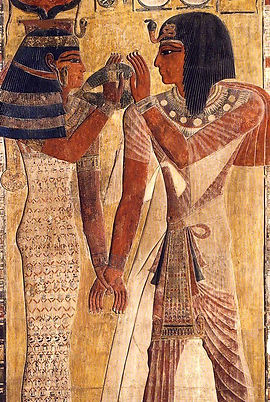
Reproduction shows a wall painting from the tomb of Ahmose, son of Ebana, at Elkab (c. 1550–1525 BC, early Dynasty 18).
Ahmose, a naval officer, inscribed one of the most detailed military autobiographies from ancient Egypt, recording his service in the wars that expelled the Hyksos. At his feet stands his grandson Pahery, a scribe of Amun, shown here overseeing the commemoration of his grandfather’s deeds.

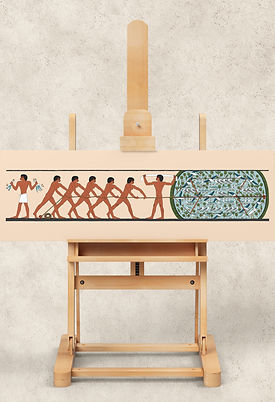
Catching Birds With a Clap-Net
Saqqara Necropolis
My reproduction of a wall relief from the Tomb of Neferiretnes, later usurped by Raemkai, dating to the 5th Dynasty (c. 2446–2389 BC).
It forms part of a larger composition surrounding the tomb’s False Door and depicts a group of men catching birds in the Nile marshes using a clap-net. Their catch is then presented as an offering to the tomb owner, intended to provide eternal sustenance in the afterlife.


Lady Tjepu
Tomb of Nebamun and Ipuky (TT181), Sheikh Abd el-Qurna, Thebes
Reproduction of a wall painting of the noblewoman Tjepu from the Tomb of Nebamun and Ipuky (TT181), dating to c. 1390–1353 BC (Dynasty 18).
Tjepu is shown standing with one hand raised in a gesture of reverence and the other holding a menat necklace, a ceremonial object linked to the goddess Hathor. Though she was likely around forty when this image was painted, Tjepu is shown as eternally youthful, in line with Egyptian ideals of the afterlife.
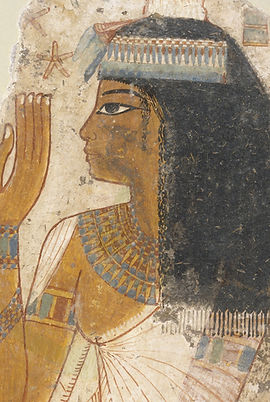

Dance for Hathor
Tomb of the Dancers, Dra Abu el-Naga, Thebes
Reproduction of a fragment of wall painting from the Tomb of the Dancers, discovered at Dra Abu el Naga, dating to c. 1630–1550 BC (Dynasty 17).
It shows a group of women mid-dance, arms raised, fingers snapping in rhythm. It likely formed part of a festival or ceremonial performance honouring Hathor, the goddess of music, dance, joy, and fertility.


The Winged Goddess Maat
Tomb of Siptah (KV47), Valley of the Kings, Thebes
Reproduction of a wall painting of the winged goddess Maat from the Tomb of Siptah (KV47), dating to c. 1197–1191 BC (Dynasty 19).
Maat, the goddess of truth, balance, and cosmic order, kneels atop a basket, her wings outstretched in divine protection. Between them, the royal cartouches of Pharaoh Siptah are accompanied by the shen symbol, representing eternity and infinite protection.


The Feast of Nebamun: Dancing in Celebration
Tomb-Chapel of Nebamun, Theban Necropolis
Reproduction of a scene from the tomb chapel of Nebamun in Thebes, c. 1350 BC.
Two women perform a graceful dance to entertain guests, surrounded by wine jugs adorned with floral garlands and grapevines—an enduring symbol of joy and prosperity in ancient celebrations.


Offering Stela of Neskhons
Petrie Museum of Egyptian and Sudanese Archaeology
Reproduction of the painted wooden funerary stela of Neskhons, wife of the High Priest of Amun, Pinedjem II, dating to c. 965 BC (Dynasty 21).
It depicts Neskhons presenting offerings to the god Osiris to gain his protection in the afterlife. The stela is displayed at the Petrie Museum of Egyptian and Sudanese Archaeology.


Sekhet Aaru, the Field of Reeds
Tomb of Sennedjem (TT1), Deir el-Medina
Reproduction of a vignette from a wall painting from the Tomb of Sennedjem (TT1) in Deir el-Medina dating to Dynasty 19.
It shows Sennedjem and his wife, Iyneferti, in the serene afterlife of Sekhet-Aaru (the Field of Reeds), where they joyfully tend the fertile fields granted to them by Osiris.
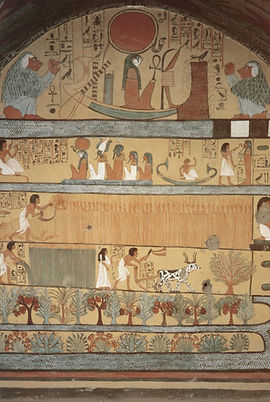

Harvesting in Sekhet Aaru
Tomb of Sennedjem (TT1), Deir el-Medina
Reproduction of a vignette from a wall painting from the Tomb of Sennedjem (TT1) in Deir el-Medina dating to Dynasty 19.
It shows Sennedjem and his wife, Iyneferti, in the serene afterlife of Sekhet-Aaru (the Field of Reeds), where they joyfully tend the fertile fields granted to them by Osiris. In this scene, they are harvesting golden wheat.


Tending Crops in Sekhet Aaru
Tomb of Sennedjem (TT1), Deir el-Medina
Reproduction of a vignette from a wall painting from the Tomb of Sennedjem (TT1) in Deir el-Medina dating to Dynasty 19.
It shows Sennedjem and his wife, Iyneferti, in the serene afterlife of Sekhet-Aaru (the Field of Reeds), where they joyfully tend the fertile fields granted to them by Osiris.


Ploughing in Sekhet Aaru
Tomb of Sennedjem (TT1), Deir el-Medina
Reproduction of a vignette from a wall painting from the Tomb of Sennedjem (TT1) in Deir el-Medina dating to Dynasty 19.
It shows Sennedjem and his wife, Iyneferti, in the serene afterlife of Sekhet-Aaru (the Field of Reeds), where they joyfully tend the fertile fields granted to them by Osiris. In this scene, they are ploughing the soil and sowing seeds.


Ramesses II in his War Chariot
Great Temple of Ramesses II, Abu Simbel
Reproduction of a wall relief from the Great Temple at Abu Simbel dating to the reign of Ramesses II in c. 1250 BC (Dynasty 19).
This relief from the Great Temple of Abu Simbel is one of many scenes in the Great Hypostyle Hall glorifying Ramesses II's military achievements. It shows the king in his chariot being pulled by two horses in full regalia, attacking a fortified town. It likely represents scenes from the Battle of Kadesh, one of the most famous military campaigns in ancient Egypt.


Tutankhamun and Ankhesenamun Amongst the Vines
Tomb of Tutankhamun (KV62), Valley of the Kings
Reproduction of a scene from a casket found in the Tomb of Tutankhamun dating to c. 1336-1327 BC (Dynasty 18).
On the casket's lid is a glorious scene depicting the royal couple in a pavilion bedecked with festoons of flowers, fruit and creeping vines bearing bunches of grapes. The king, leaning slightly on his walking-staff, accepts bouquets of lotus and papyrus flowers from his wife, Ankhesenamun.


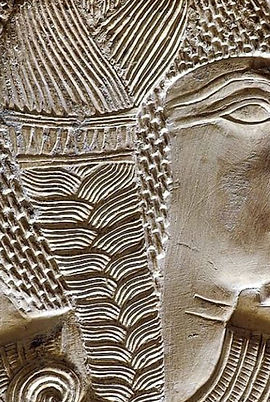

Fighting With Sticks
Pyramid of Sahure, Saqqara Necropolis
Reproduction of a stone block from the Pyramid causeway of King Sahure showing soldiers training in the art of stick fighting.
At 4,500 years old, this is one of the earliest depictions in ancient Egypt of soldiers being trained. Each pair consists of a student in a loincloth practising against an instructor in a kilt. The hieroglyphics show the instructor's words of encouragement and direction.


Lessons in Archery
Pyramid of Sahure, Saqqara Necropolis
Reproduction of a stone block from the Pyramid causeway of King Sahure showing an archer in training guided by an instructor in three scenes.
At 4,500 years old, this is one of the earliest depictions in ancient Egypt of soldiers being trained. Each pair consists of a student in a loincloth practising against an instructor in a kilt. The hieroglyphics show the instructor's words of encouragement and direction.


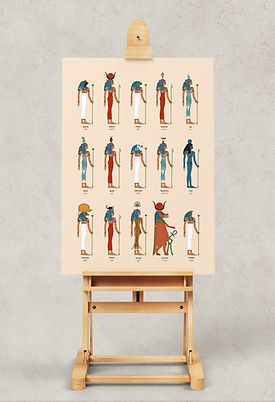
30 Gods and Goddesses
Thirty of the major gods and goddesses of the ancient Egyptian pantheon are shown with their modern names and their names in the ancient Egyptian language.
It includes Amun, Anubis, Bastet, Geb, Hapi, Hathor, Heqet, Horus, Imentet, Isis, Khepri, Khnum, Khonsu, Maat, Montu, Neith, Nekhbet, Nephthys, Nut, Osiris, Ptah, Ra, Sekhmet, Serket, Seshat, Seth, Sobek, Taweret, Thoth, and Wadjet.



Two Brothers: The Coffins of Nakhtankh and Khnumnakht
Tomb of Two Brothers, Deir Rifeh
Reproduction of the inner coffins belonging to brothers Khnumnakht (left) and Nakhtankh (right) who lived during Dynasty 12.
Found in the Tomb of the Two Brothers, these coffins are adorned with vivid hieroglyphs, protective symbols, and intricate motifs, reflecting the brothers’ journey to the afterlife.


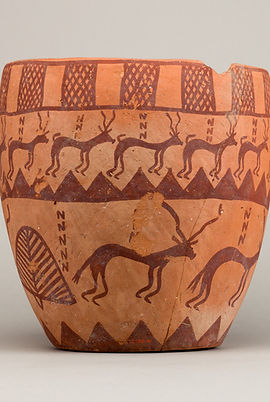
Antelope Hunt in the Desert Valley
Unprovenanced
Reproduction of a Naqada II period pottery jar in the Metropolitan Museum collection dating to around c. 3650-3300 BC.
In the lower band, larger antelope with elongated tails and twisted horns are depicted amidst sedges or palm trees. In the central band smaller antelope with upright tails also run in a hilly environment, whilst above them is a stylised representation of hunting nets. Interrupting the recurring motif are the hunters; two men holding sticks who flank a woman or goddess.
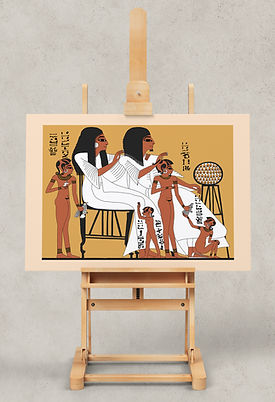
The Bird to My Hand! Inherkhau and his Grandchildren
Tomb of Inherkhau (TT359), Theban Necropolis
Reproduction of a Dynasty 20 painting showing grandchildren playing at the feet of their grandparents from the Tomb of Inherkhau (TT359).
Inherkhau is seated beside his wife Wabet whilst four of their grandchildren play with birds around them. The three girls and a boy are naked with shaved heads and sidelocks of hair, characteristics used in ancient Egyptian art to symbolise youth.


Isis and Nephthys Protect Tutankhamun
Tomb of Tutankhamun (KV62), Valley of the Kings
Reproduction and colourisation of a scene from the rear panel of the second golden shrine of Tutankhamun, dating to 1324 BC.
The sister goddesses Isis and Nephthys stretch out their protective wings to encircle the dead king. They recite spells that emphasise the rejuvenation and protection of Tutankhamun in the afterlife, whose names are given in cartouches.


The Creation of the World: Nut, Geb and Shu
Theban Necropolis
Reproduction of a vignette from a copy of the Book of the Dead belonging to a woman called Nestanebetisheru, dating to c. 950-930 BC (Dynasty 21-22).
Nut, the sky goddess, is supported by the god of the atmosphere, Shu, who is aided in his task by two ram-headed deities. Her elongated body arches over the reclining figure of Geb, the earth god, with her feet touching the ground at the eastern horizon and her fingers at the western horizon.


Ramose's Wedding Guests
Tomb of Ramose (TT55), Valley of the Nobles
Reproduction of a wall painting from the Tomb of Ramose (TT55) in the Valley of the Nobles, dating to c. 1380-1360 BC in the 18th Dynasty.
In the entrance hallway, this famous scene depicts Ramose’s wedding to his brother's daughter Meryt-Ptah. The high-status guests are all seated in couples upon cushions on lion-footed chairs. They wear fine linen clothes and elaborate wigs suitable for the important occasion.


Hathor in the Mountains
Theban Necropolis
Reproduction of an illustration from Chapter 186 of the Book of the Dead, discovered in the burial of the Royal Scribe Ani from c. 1250 BC.
In this depiction, the goddess Hathor manifests in her sacred cow form, emerging from a thicket of papyrus amidst the pink cliffs of the Theban desert. Hathor, associated with music, dance, and fertility, was revered as a nurturing and protective deity in ancient Egyptian religion. The imagery symbolises Hathor's connection to the natural world and her role in guiding souls through the afterlife.


The Abydos King List
Great Temple of Seti I, Abydos
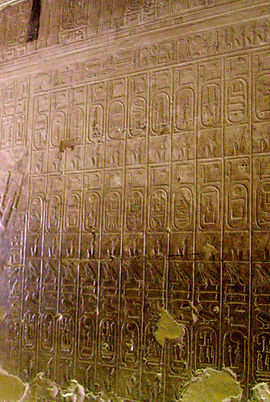
Reproduction of a wall relief from the Great Temple at Abydos dating to the reign of Seti I in c. 1290-1279 BC (Dynasty 19).
The King List records the names of 76 rulers inside cartouches from the previous 1,600 years. The hieroglyphics describe the prayers that Seti and his son Ramesses are reciting for the past kings. Besides providing the order of the Old Kingdom kings, the Abydos King List is the sole source to date of the names of many of the kings of Dynasty 7 and 8.
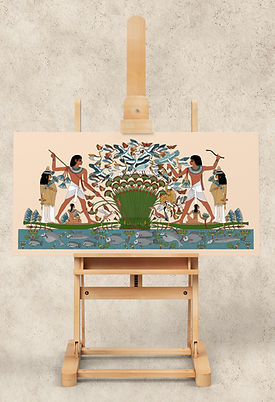
Nebamun Hunting in the Marshes (Reconstruction)
Tomb-Chapel of Nebamun, Theban Necropolis
Reproduction of a tomb painting from the 18th Dynasty tomb chapel of Nebamun, with a reconstruction of the missing elements.
Nebamun is shown twice, hunting birds in small reed boats in the marshes of the Nile with his wife Hatshepsut and their young daughter.


Anubis, Isis and Nephthys Inside the Embalming Tent
Tomb of Siptah (KV47), Valley of the Kings, Thebes
Reproduction of a wall painting from the tomb of Siptah, who ruled c. 1197-1191 BC during Dynasty 19.
Filling the southern end of the second corridor is a vignette of Chapter 151 of the Book of the Dead which contains passages dedicated to the gods and goddesses that reside within the embalming tent.


Tilapia Fish Amongst the Lotus Flowers (The Marsh Bowl)
Abydos, Tomb 949
Reproduction of a blue faience bowl found with a large group of vessels in a tomb in Abydos dating to Dynasty 18, c. 1550-1292 BC.
It shows a marsh scene with water, fish, and plant motifs that symbolise the themes of fertility, rebirth, and regeneration. Lotus flowers, lotus buds, and papyrus plants are shown being circled by tilapia fish, whilst the wall of the bowl is decorated with swirling water-like patterns.

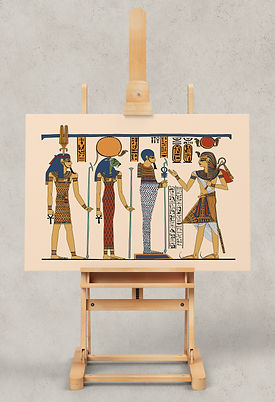
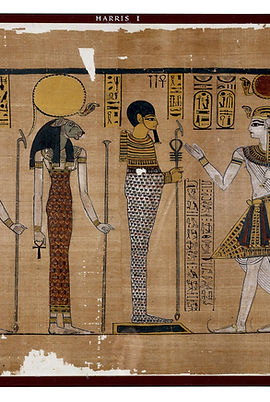
The Triad of Memphis
Thebes
Reproduction of a vignette from the Great Harris Papyrus which recorded the deeds of king Ramesses III in c. 1150 BC (Dynasty 20).
Ramesses stands before the holy family of the ancient city of Memphis: Ptah, the patron of craftsmen, his consort the lion-headed goddess Sekhmet, and their child, Nefertum, god of the lotus. The king is shown making offerings to the resident deities, with hieratic text identifying each of the figures and recording his address to Ptah and the Memphite Triad.
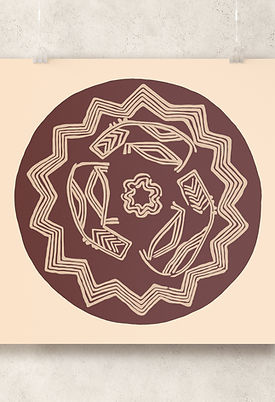
Hippos by the River (Naqada Bowl)
Mesaid, Mesaid Tomb 26
Reproduction of a prehistoric white cross-lined ware bowl from the Naqada I period (c. 3850–3650 BC). It depicts three stylised hippos gathered around a central rosette representing a pool of water with zigzag cliffs beyond representing the horizon.
Wild creatures such as hippos and crocodiles are often found depicted on this type of pottery found in graves and it’s thought they were intended to impart their powers on the vessels' owners, granting them success hunting and protection from danger in the afterlife.


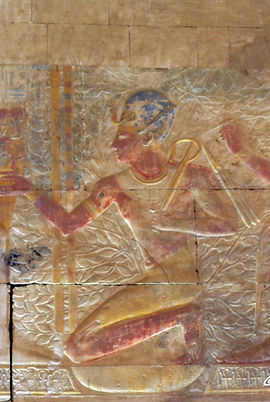
Seti Beneath the Persea Tree
Great Temple of Seti I, Abydos
Reproduction of a wall painting from the Great Temple at Abydos dating to the reign of Seti I in c. 1290-1279 BC (Dynasty 19).
The kneeling figure of Seti holds a jewel out to the god Ptah, who sits in a golden shrine. The symbolism in the cunningly wrought jewel is asking for Seti to be granted millions of jubilees and unending life. Both Ptah and Re-Horakhty are giving their approval for Seti, and writing his name into the leaves of the Persea Tree to grant him eternal life and power.

The Sculptors' Craft Workshop
Tomb of Nebamun and Ipuky (TT181), Sheikh Abd el-Qurna
Reproduction and partial reconstruction of a wall painting showing a bustling craft workshop from the tomb of Nebamun and Ipuky dating to Dynasty 18.
The top register shows a group of woodworkers building a catafalque. The middle register shows craftsmen working with gold and precious stones to create beautiful vessels, statues, and jewellery. The bottom register shows craftsmen making and working with metal, as well as specialist tasks such as drilling and carving beads and alabaster.


Queen Nefertari Making Offerings to the God Ptah
Tomb of Nefertari (QV66), Valley of the Queens
Reproduction of a wall painting from the tomb of Queen Nefertari, Great Wife of Ramesses II, in the Valley of the Queens dating to Dynasty 19.
In this scene from the west wall of the first eastern annexe, Nefertari is making offerings of linen to the god Ptah, the creator god of weaving and crafts. Whilst it does not feature in the Book of the Dead, this depiction was included to ensure Nefertari would be well provisioned in the afterlife, with the blessing of the god.


Anubis Guarding the Tomb of Pashedu
Tomb of Pashedu (TT3), Deir el-Medina
Reproduction of a tomb painting from the Tomb of Pashedu in the worker's village of Deir el-Medina.
The corridor to the burial chamber is guarded by a large painting on either wall of the god Anubis in the form of a black jackal, sitting alert on a shrine with cavetto cornices. Since the first dynasty of Egypt’s history in c. 3100 BC, Anubis was being depicted as a protector of graves

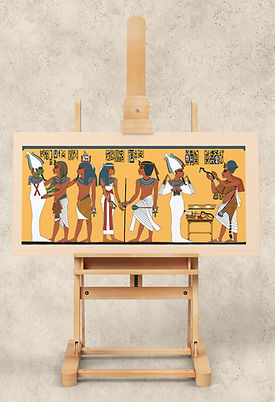
The Burial Chamber of Tutankhamun
Tomb of Tutankhamun (KV62), Valley of the Kings
Reproduction of a painting on the north wall of the burial chamber of Tutankhamun dating to Dynasty 18, c. 1325 BC.
It shows how Tutankhamun journeyed into the afterlife in three acts. In the first act, his mummy is prepared for the afterlife, in the second he meets the goddess of the sky Nut, and in the third, he is embraced by Osiris, the god of the underworld.


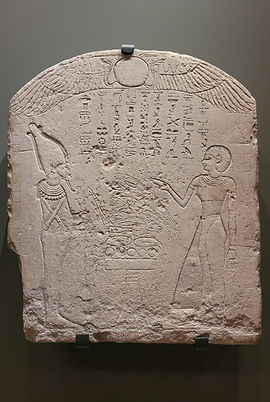
Inamun Making Offerings to Osiris
Abydos
Reproduction stone stela from Abydos made in c. 747-656 BC which enabled votive offerings to be given to the deceased spirit of a woman called Inamun Nayesnebu.
Inamun stands beneath the text wearing a fine linen dress and her natural hair fastened with a band. Before her is an offering table laden with bread, fowl, oxen and lotus flowers, upon which she is pouring a libation from a small bottle. The offerings are being given to the mummified human-headed god Osiris, who holds a flail and a sceptre and is wearing his distinctive plumed headdress.

Trio of Female Musicians Playing Music
Tomb of Nakht (TT53), Sheikh Abd el-Qurna
Reproduction of a detail from a painting in the Tomb of Nakht in Thebes dating to c. 1410-1370 BC depicting a trio of musicians taking part in the annual "Beautiful Festival of the Valley" celebration.
Each woman has unique features that separate her from her companions and are playing different instruments, including a double flute, a lute, and a harp with an elaborate soundbox decorated with animal skin.


Maat, the Winged Goddess of Truth
Tomb of Nefertari (QV66), Valley of the Queens
Reproduction of the Goddess Maat based on a painting in the tomb of Queen Nefertari in the Valley of the Queens.
The Ancient Egyptians believed the balance of the universe was determined by the presence or absence of maat, which had the meaning of rightness, truth, justice and order. Without maat, there was isfet or chaos, and Maat wears an ostrich feather on her head, which could be used alone as the symbol for her name, and is often shown with protective wings.


Iah-Thoth Recieving the Wadjet Eye
Deir el-Medina
Reproduction of a Dynasty 19 stela dedicated to the deceased spirit of Neferrenpet, a sculptor from Dier el-Medina, the workman’s village c. 1279-1213 BC.
The inscription praises the healing power of the god Iah-Thoth, who is shown as an ibis-headed man, riding on the solar barque through the night sky. The god is being presented with a Wadjet, or Eye of Horus, by the baboon-form of Thoth, which represents the healing power and protection of the god.


Akhenaten, Nefertiti and Family Beneath the Aten
Amarna, Akhetaten
Reproduction of a Dynasty 18 stela found in a private home in Amarna depicting the heretical king Akhenaten and his family worshipping the sun god Aten.
Akhenaten and his wife Queen Nefertiti are shown seated on cushioned stools bearing the sema-tawy symbol. Between them stands their eldest daughter, Meritaten and the younger daughters Meketaten and Ankhesenpaaten sit on Nefertiti’s lap. Above the royal family is the red disk of the sun god Aten, whose rays reach out towards the family and end in hands holding Ankhs, the symbol of life.


Userhat Beneath the Sycamore Tree
Tomb of Userhat (TT56), Thebes, Theban Necropolis
Adapted reproduction of a painting from the Tomb of Userhat in Thebes, Egypt dating to c. 1270 BC.
In this scene, the deceased Userhat sits with his wife and mother in the shade of a colourful sycamore tree and drinks from three golden vessels. Before them is a table laden with offerings of fruit, vegetables and flowers, whilst their souls in the form of Ba-birds fly above their heads.


Userhat Beneath the Sycamore Tree with the Goddess Nut
Tomb of Userhat (TT56), Thebes, Theban Necropolis
Reproduction of a painting from the Tomb of Userhat, a wab-priest in the mortuary cult of Thutmosis I, dating to Dynasty 19.
The deceased Userhat meets Nut, the goddess of the sycamore tree. He sits with his wife and mother sit in the shade of a colourful tree and is receiving the water Nut is pouring for them in three golden vessels. Before them is a table laden with offerings of fruit, vegetables and flowers, whilst their souls in the form of Ba-birds fly above their heads and stand on a T-shaped pool.

Hathor and Opet (Spell 186, Book of the Dead)
Theban Necropolis
Reproduction of an illustration of Chapter 186 of the Book of the Dead buried with the Royal Scribe Ani c. 1250 BC.
It shows two protective goddesses welcoming Ani to his final resting place, a white pyramidion-topped private tomb nestled within the pink cliffs of the Theban desert. The goddess Hathor can be seen in her cow form emerging from a thicket of papyrus and is joined by the benign hippopotamus goddess Opet.

Tutankhamun and Ankhesenamun in a Floral Pavilion
Tomb of Tutankhamun (KV62), Valley of the Kings
Reproduction of the backrest of the golden throne of Tutankhamun dated to Dynasty 18 (c. 1336-1327 BC), now in the Egyptian Museum, Cairo.
One of the masterpieces of Egyptian art and workmanship, the throne features an evocative image of the young king with his wife, Ankhesenamun, in a floral pavilion. Picked out in a variety of precious metals and gemstones is Tutankhamun, reclining on a throne as Ankhesenamun rubs perfume into his shoulders from the bowl she is carrying.


Brothers or Lovers? Niankhkhnum and Khnumhotep
Mastaba of Khnumhotep and Niankhkhnum, Saqqara Necropolis
Reproduction of a tomb painting from the Dynasty 5 Mastaba of Khnumhotep and Niankhkhnum.
On the western wall of the outer hall of their tomb is a striking portrayal of the two men in close embrace, their noses touching in a pose that is the most intimate allowed in Egyptian art. This has led many to speculate on the relationship of the two men; were they brothers? Twins? Lovers? If the latter were true, they would be the first same-sex couple recorded in history.


Stela of Kay, Head of the Desert Hunters
Qamula, Thebes
Reproduction of the Stela of Kay dated to early Dynasty 12 (c. 1976-1912 BC), now in the Neues Museum, Berlin.
Picked out in raised relief is Kay, accompanied by an unnamed woman assumed to be his wife or mother Beshet, and five hunting dogs. The inscription is designed to give offerings to Kay for his afterlife and recounts his service to the king by patrolling the western oases and tracking down fugitives.


A Walk in the Garden
Amarna, Akhetaten
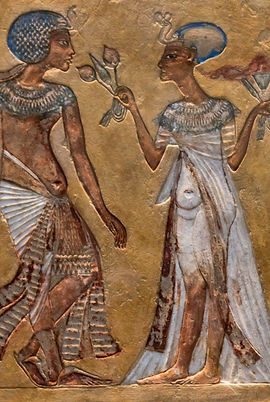
Reproduction of a relief usually referred to as a “walk in the garden” dating to Dynasty 18 showing an unknown pharaoh and queen now in the Neues Museum in Berlin.
The pharaoh wears a blue curly wig and a white linen kilt tied with red sashes and is leaning on a walking stick. His queen is wearing a flowing white linen robe tied with red sashes and is presenting the king with flowers from the garden.
Tutankhamun's Death Mask
Tomb of Tutankhamun (KV62), Valley of the Kings
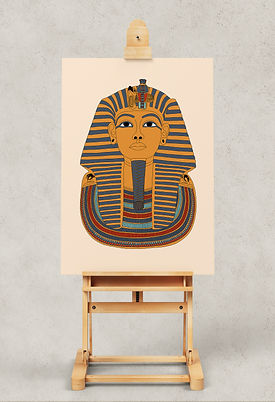
Reproduction of the golden death mask of King Tutankhamun, one of the most iconic and captivating artefacts from ancient Egypt.
Crafted during Dynasty 18, around 1323 BC, the intricately detailed mask was discovered in the pharaoh's burial chamber in the Valley of the Kings. The face of the mask represents the young Tutankhamun with delicate features and a serene expression, symbolising the pharaoh's peace in the afterlife.

Amenhotep I Deified
Theban Necropolis
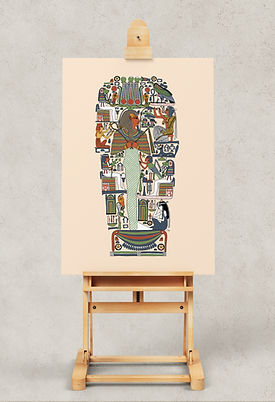
Reproduction of the interior decoration of a coffin belonging to an unknown person who lived during the Third Intermediate Period, c. 1070-945 BC.
Most of the interior is taken up with the image of King Amenhotep I in the guise of the mummiform Osiris, who is attended by a priest in a panther skin, a human-headed ba-bird representing the spirit of the coffin's owner, and a crouching mourning woman.


The Goddess Nekhbet in Vulture Form
Mortuary Temple of Hatshepsut, Deir el-Bahri
Reproduction of the vulture-form Goddess Nekhbet, originating from the Mortuary Temple of Hatshepsut at Deir el-Bahri.
Nekhbet, often depicted as a vulture, held significant importance in ancient Egyptian religion as a protective deity, particularly associated with Upper Egypt. Her representation adorned sacred spaces, symbolising protection and divine guardianship over the pharaoh and the land. The vulture imagery evoked the nurturing and watchful aspects of the goddess, emphasising her role in safeguarding the king and ensuring the prosperity of the kingdom.


A Prehistoric Hippo Hunt, Naqada Bowl
Unprovenanced
Reproduction of a prehistoric white cross-lined ware bowl from the Naqada period (c. 3700-3450 BC).
A man wearing a penis sheath and an animal’s tail can be seen holding two cords attached to harpoons now embedded in the face of the large hippo that faces him. A second smaller hippo, behind the first, shares the same fate. The zig-zag patterns represent the landscape the hunt is taking place within.


Khepri and Thoth’s Sacred Baboons
Unprovenanced
Reproduction of a relief panel of a sacred scene rich in solar and lunar symbolism dating to approximately 380–343 BC, during the Late Period–early Ptolemaic era.
At its centre is Khepri, the scarab beetle deity associated with the rising sun, transformation, and rebirth. Flanking him are two baboons, creatures sacred to the god Thoth, who offer Wadjet eyes in an act of devotion and restoration.


Scribe Neqbed Praising Osiris and Nekhbet Afterlife
Theban Tomb TT319, Thebes, Theban Necropolis
Reproduction of a vignette from the Book of the Dead created for the royal scribe Nebqed, scribe of Ma'at in the house of Ma'at during the reign of king Amenhotep III around 1400 BC.
Nebqed can be seen wearing standing before a pile of funerary offerings, including bundles of lotus flowers, baskets of fruits and grain, bread, fowl and cuts of meat. He wears a wig with triangular stepped sides, a white linen robe, and a scribal palette tucked into his belt.


The Feast of Nebamun: Music of Celebration
Tomb-Chapel of Nebamun, Theban Necropolis
Reproduction of a feasting scene from the tomb chapel of Nebamun in Thebes, Egypt, now on display in the British Museum.
It shows a group of female musicians playing instruments, singing and clapping as they perform a song for the feast-goers.


The Feast of Nebamun: Singing in Celebration
Tomb-Chapel of Nebamun, Theban Necropolis
Reproduction of a feasting scene from the tomb chapel of Nebamun in Thebes, Egypt, now on display in the British Museum.
It shows a group of female musicians playing instruments, singing and clapping as they perform a song for the feast-goers.


The Feast of Nebamun: The Entertainers
Tomb-Chapel of Nebamun, Theban Necropolis
Reproduction of a feasting scene from the tomb chapel of Nebamun in Thebes, Egypt, now on display in the British Museum.
It shows a group of female musicians playing instruments, singing and clapping as they perform a song for the feast-goers. The words of the song dedicated to the gods Ptah and Geb are written above their heads.

Tutankhamun Pouring Perfume For Ankhesenamun
Tomb of Tutankhamun (KV62), Valley of the Kings
Reproduction based on a small panel found on a golden statue shrine known as a noas found in the treasury room of Tutankhamun’s tomb dating to around 1324 BC.
Tutankhamun is sitting on a lion-footed ebony folding stool and holds a bouquet of lotus flowers and mandrake fruits. He is pouring perfume into the hands of his wife and sister, Ankhesenamun, who holds it close to her nose as if to smell its fragrance.
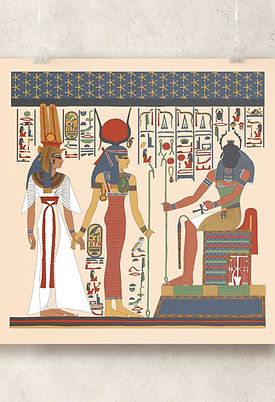
Queen Nefertari, Goddess Isis and Beetle-Headed Sun God Khepri
Tomb of Nefertari (QV66), Valley of the Queens
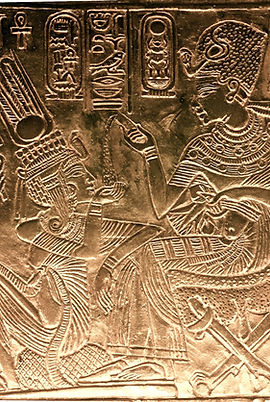
Reproduction of a painting from the tomb of Queen Nefertari in the Valley of the Queens dating to Dynasty 19.
The Great Wife of Ramesses II is being led by the hand of the goddess Isis towards Khepri, the beetle-headed sun god.
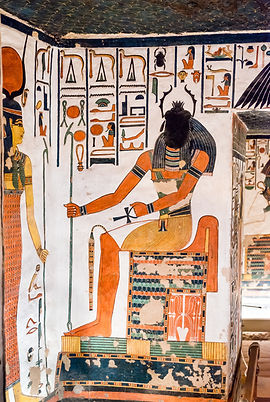

Queen Nefertari and the Goddess Isis
Tomb of Nefertari (QV66), Valley of the Queens
Reproduction of a painting from the tomb of Queen Nefertari, Great Wife of Ramesses II, in the Valley of the Queens dating to Dynasty 19.
In this scene from the northeast wall of the vestibule, Nefertari is being led by the goddess Isis, who says: “By my hand, come, Great Wife of the King, Nefertari Meritenmut, true of voice, to a place in the sacred land”.

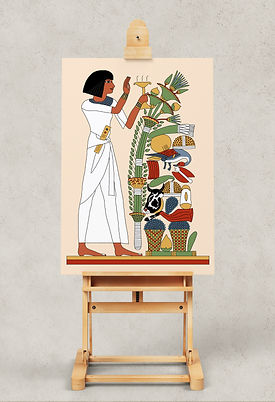
The Scribe Nebqed with Funerary Offerings
Theban Tomb TT319, Thebes, Theban Necropolis
Reproduction of a vignette from the Book of the Dead created for the royal scribe Nebqed, scribe of Ma'at in the house of Ma'at during the reign of king Amenhotep III around 1400 BC.
Nebqed can be seen wearing standing before a pile of funerary offerings, including bundles of lotus flowers, baskets of fruits and grain, bread, fowl and cuts of meat. He wears a wig with triangular stepped sides, a white linen robe, and a scribal palette tucked into his belt.


King Den Running in his Heb-Sed Festival
Tomb of Den (Tomb T), Umm el-Qaab, Abydos
Reproduction of a label depicting one of the earliest known pharaohs, the Dynasty 1 king Den, as well as some of the earliest hieroglyphs.
It was found in his tomb in Abydos and dates to around 3000 BC. The top register depicts the king running in his Heb Sed festival as well as seated on a throne, whereas the lower register depicts the destruction of enemy strongholds and the taking of captives.


The Offering Table of Watetkhethor
Mastaba of Mereruka, Saqqara Necropolis
Reproduction of a wall painting in the tomb of Watetkhethor, daughter of king Teti, dating to Dynasty 6 (around 2290 BC).
It shows Watetkhethor seated in front of a table of offerings, whilst servants bring her legs of meat and birds to add to her piles of bread and gifts of flowers. The offering scene was the most important piece of art in an Ancient Egyptian tomb, as it provided the spells necessary for the deceased to continue eating and drinking in the afterlife.


The Pharaoh Seti with Horus, Thoth and the Two Ladies
Great Temple of Seti I, Abydos
Reproduction of a wall relief from a chapel in the Temple of Seti I, dating to Dynasty 19 (around 1290–1279 BC).
The king sits between the Two Ladies, the vulture goddess Nekhbet of Upper Egypt, and the cobra goddess Wadjet, her counterpart in Lower Egypt, surrounded by symbols relating to the concept of unity. The ritual unification of the Two Lands is also symbolised by the sema-tawi symbol, combining a knotted papyrus plant representing Upper Egypt and a reed plant representing Lower Egypt.
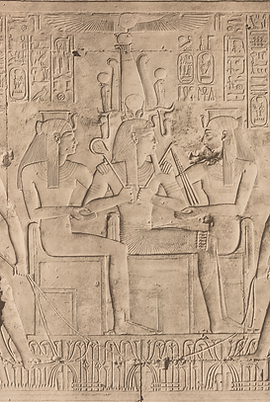

Seshat, Thoth and the Persea Tree
Ramesseum, Theban Necropolis
Reconstruction of a partially destroyed wall relief from the Ramesseum, the mortuary temple dedicated to Ramesses II in Thebes dating from the 19th Dynasty.
The scene depicts the deities Atum, Seshat and Thoth inscribing the name of Rameses into the fruit of the Persea, the sacred tree of Heliopolis. By doing this the gods are guaranteeing Rameses an everlasting reign and innumerable jubilees.

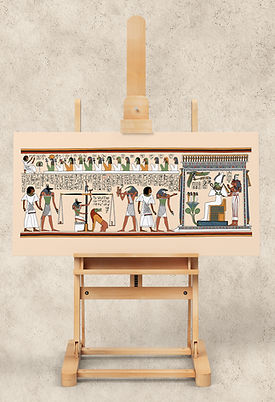
The Weighing of Hunefer’s Heart in the Presence of the Gods
Theban Necropolis
Reproduction of a vignette from the Ancient Egyptian Book of the Dead, taken from the Papyrus of Hunefer from c. 1285 BC.
It depicts Hunefer during the Weighing of the Heart before the gods in the underworld and contains the spells he’d need to safely pass judgement by Osiris and the gods of the Ennead.


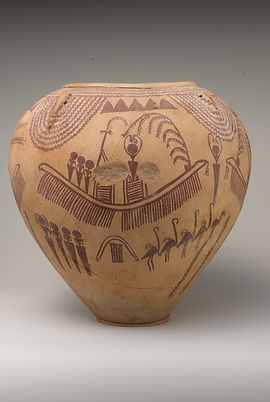
A Festival on the River Nile, Naqada Pot
Unprovenanced
Reproduction of a Naqada II period pottery jar in the Metropolitan Museum collection dating to around c. 3450 to 3330 BC.
It depicts three boats travelling in procession within the Nile Valley landscape, with desert ibex shown in close proximity to flying birds and mountains, as well as flamingos surrounded by water plants. The boats each hold a different set of figures accompanied by individual standards, acting a ceremony or ritual and being observed by groups of people on the land nearby.

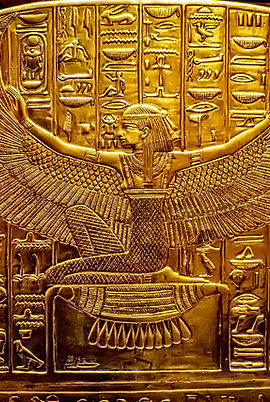
The Winged Goddess Isis
Valley of the Kings, Tomb of Tutankhamun (KV62)
Reproduction of the ancient Egyptian goddess Isis, with protective wings outstretched, taken from the golden shrine of Tutankhamun dating to 1324 BC.
The hieroglyphics surrounding the goddess are spells from the Book of the Dead and Tutankhamun’s various names and titles are given in cartouches.
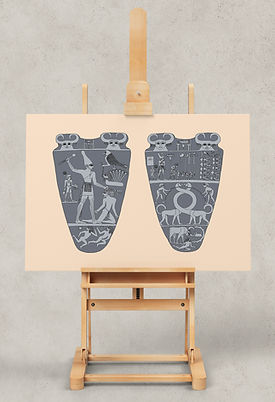
The Unification of Egypt (Narmer Palette)
Hierakonpolis
Reproduction of the Narmer Palette, an emblem of ancient Egyptian sovereignty from the time of the first pharaohs.
Dating to the Early Dynastic Period, c. 3100 BC, this artefact symbolises the unification of Upper and Lower Egypt under King Narmer. Carved on schist, it depicts scenes of conquest and divine authority, showcasing the pharaoh's role as the intermediary between gods and people.


Tree of Life with Exotic Birds
Tomb of Khnumhotep II (BH3), Beni Hassan
Reproduction of a painting from the tomb of Khnumhotep II, a provincial governor in Beni Hasan, dating to 1900 BC.
It shows the Tree of Life, a potent symbol and icon in ancient Egyptian mythology. The fruit of the tree was thought to provide eternal life and knowledge of the cycles of time. It is part of a much larger scene depicting Khnumhotep hunting in the marshes and netting birds.


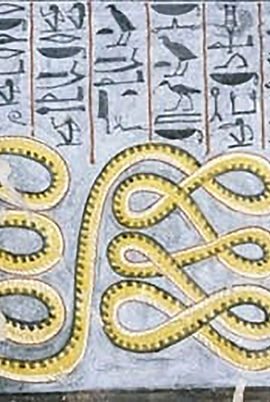
Atum Repelling Apep in the Underworld
Tomb of Ramesses I (KV9), Valley of the Kings, Thebes
Reproduction of a scene from the ancient Egyptian Book of Gates showing the creation god Atum repelling the serpent of chaos, Apep (Apophis).
The Book of Gates is a funerary text that narrates the passage of a newly deceased soul into the next world, corresponding to the journey of the sun through the underworld during the hours of the night.
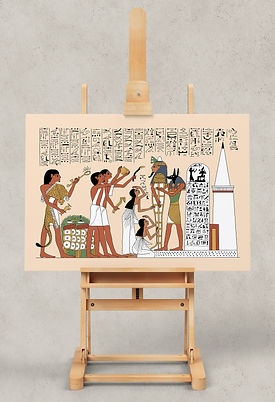
The Opening of the Mouth Ceremony
Theban Necropolis
Reproduction of a vignette from the Ancient Egyptian Book of the Dead, taken from the Papyrus of Hunefer from c. 1450 BC.
The mummy of Hunefer is supported by the god Anubis (or a priest wearing a jackal mask) whilst Hunefer's wife and daughter mourn, and three priests perform rituals. The two priests with white sashes are carrying out the Opening of the Mouth ritual (Spell 22).


Ramesses II as a Child
Unprovenanced
Reproduction of a bas-relief depicting Ramesses II in the pose of a child from the New Kingdom.
Ramesses is depicted in the traditional pose of a child, seated on a soft cushion, his finger to his lips, and his head bare except for a braid of hair falling to one side. The cushion reproduces the hieroglyphic sign of the akhet or horizon.

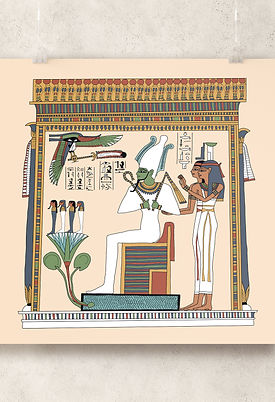
Osiris, Isis and Nephthys
Theban Necropolis
Reproduction of a vignette from the ancient Egyptian Book of the Dead, taken from the Papyrus of Hunefer from c. 1450 BC.
It shows the god of the underworld Osiris sitting within a shrine and flanked by his sisters Isis and Nephthys. He is listening to the evidence from Hunefer’s judgement and granting him admittance in the afterlife.


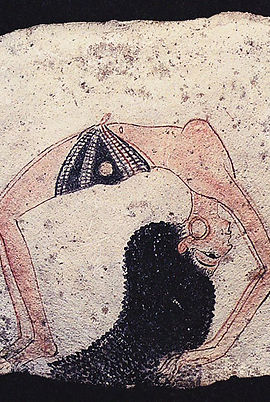
Dancing Girl
Unprovenanced
Reproduction of a dancing girl, taken from an ostracon fragment dating to c. 1200 BC, now in Museo Egizio in Turin.
Dance held profound significance in ancient Egyptian culture. Dance groups were a common sight at dinner parties, banquets, and within the sacred halls of religious temples. Professional ensembles, comprising singers (ḥsı͗t), musicians (ḥnı͗t or ḥnwt), and dancers (ḥbw), often performed at important festivals and funerary services.

Thoth Holding the Eye Of Horus
Medinet Habu
Reproduction of a detail from a 20th Dynasty hieratic papyrus found in a tomb near Medinet Habu.
Thoth, the god of wisdom and writing, is shown in his baboon form holding an Eye of Horus symbol. This refers to an ancient myth describing a battle between Horus and Set in which Horus´ right eye was torn out. Thoth magically restored Horus' eye, at which point it was given the name “Wadjet” meaning “whole”.
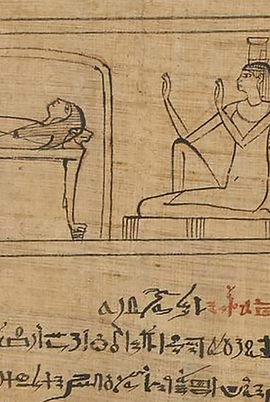

The Weighing of the Heart in the Hall of Judgement
Theban Necropolis
Reproduction of a scene from the Book of the Dead, taken from the Papyrus of Ani dating from c. 1250 BC.
It depicts Ani during the Weighing of the Heart before the gods in the underworld and contains the spells he’d need to safely pass this judgement.

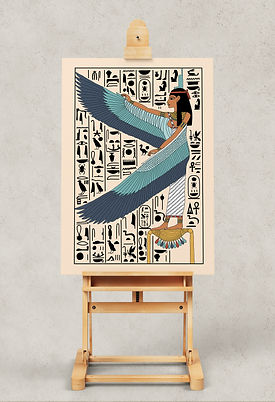
The Protective Wings of Isis
Tomb of Tutankhamun (KV62), Valley of the Kings
Reproduction of the ancient Egyptian goddess Isis, with protective wings outstretched, taken from the golden shrine of Tutankhamun dating to 1324 BC.
The hieroglyphics surrounding the goddess are spells from the Book of the Dead and Tutankhamun’s various names and titles are given in cartouches.

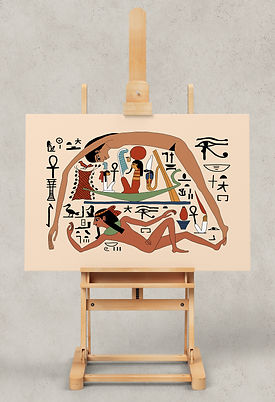
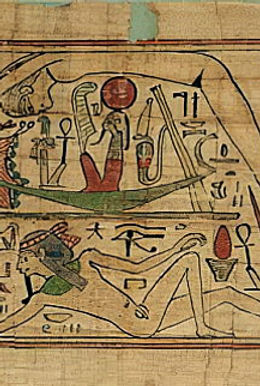
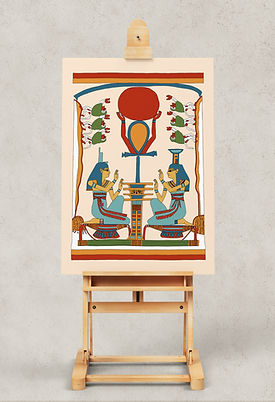
The Hymn to Ra: Isis and Nephthys
Theban Necropolis
Reproduction of a vignette from a 19th Dynasty copy of the Book of the Dead.
The motif symbolises rebirth and the sunrise and shows the sun disc of the god Ra raised into the sky by an ankh-sign (signifying life) and a djed-pillar (signifying stability and the god Osiris). It is being adored by the sister goddesses Isis and Nephthys, and baboons.


Nebamun Hunting in the Marshes
Tomb-Chapel of Nebamun, Theban Necropolis
Reproduction of a tomb painting from the 18th Dynasty tomb chapel of Nebamun.
Nebamun is shown hunting birds in a small boat with his wife Hatshepsut and their young daughter, in the marshes of the Nile. The hieroglyphic caption says Nebamun is "taking enjoyment (and) seeing good things".
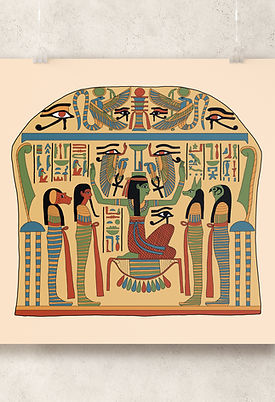
Nephthys and the Sons of Horus
Theban Necropolis
Reproduction of a scene from the Book of the Dead, taken from a Dynasty 21 coffin belonging to a man called Nespawershefyt.
The scene portrays the goddess Nephthys, accompanied by the four Sons of Horus, divine entities crucial for safeguarding and preserving the body in the afterlife. Qebehsenuef protects the intestines, Hapi guards the lungs, Duamutef watches over the stomach, and Imsety safeguards the liver.

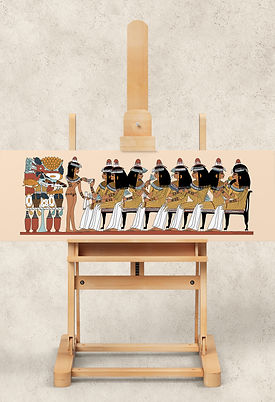
The Feast of Nebamun: Celebrating Guests
Tomb-Chapel of Nebamun, Theban Necropolis
Reproduction of a feasting scene from the 18th Dynasty tomb chapel of Nebamun in Thebes.
The plastered walls of the scribe's tomb were richly and skilfully decorated with lively fresco paintings, depicting idealised views of Nebamun’s life and activities. An entire wall shows a banquet in his honour. Naked serving girls and servants wait on his friends, colleagues and relatives, who are entertained by musicians and dancers.


The Goddess Hathor and King Seti I
Tomb of Seti I (KV17), Valley of the Kings, Thebes
Reproduction of a bas-relief from the tomb of Seti I, showing Hathor welcoming the dead pharaoh.
This beautiful relief was part of the decoration of the tomb well-preserved tomb of King Seti I (KV17) in the Valley of the Kings. It depicts the Pharoah, Seti, walking towards the still figure of the goddess Hathor, who played an important role in welcoming the dead to the underworld and accompanying them into the afterlife.